Core components: lexer, parser, analyzer, interpreter/compiler path, runtime support, and STL.
pepolang --report based overview
University Coursework
PepoLang
A multipurpose language project developed for CI601, intended as a beginner-friendly midpoint between Java-style structure and Python-like accessibility.
> approach: grammar-first language design
> stack: Java / Gradle / LLVM exploration
> delivery: working interpreter pipeline
Repository Stats
Total Commits
39
Open Issues
0
Last Updated
1 year ago
May 20, 2025, 11:25 PM UTC
Stars
1
Languages
Java 100%
Language Requirements
- 1No whitespace/indentation requirements.
- 2Braces required for explicit block boundaries.
- 3Semicolons required for statement termination.
- 4Basic standard library functionality.
- 5Familiar C-style language feel for easier onboarding.
Project Objectives
Sample application objective: read current time, append to file, print file contents.
Strong error handling and clear diagnostics for beginner usability.
Research and Design Decisions
Grammar and Formalism
Research covered BNF/EBNF approaches, with grammar-first design used to anchor later implementation.
Compiled vs Interpreted Trade-off
Performance and flexibility were evaluated; project progressed with an interpreter-first path under time constraints.
Tooling Choices
Java + Gradle + JUnit were selected for familiarity, modular project structure, and testability.
Technical Findings from the Report
Lexical Analysis
- Compared regex-driven tokenization with FSM-based approaches (DFA/NFA trade-offs).
- Identified token-order sensitivity as a practical lexer pitfall (e.g., overlaps between token classes).
- Implemented lexer iteration with explicit EOF handling and comment skipping behavior.
Parsing Strategy
- Adopted recursive descent parsing for implementation speed and direct grammar mapping.
- Researched LL/LR, top-down vs bottom-up parsing, and parser-generator alternatives.
- Built AST generation workflow to support downstream semantic and execution phases.
Semantic Analysis
- Focused on type consistency, scope resolution, and identifier declaration checks.
- Explored symbol-table responsibilities (type metadata, scope, downstream compiler data).
- Found data-structure constraints in symbol handling that later impacted codegen progress.
Implementation Timeline
Lexer
Tokenization implemented as the first complete stage, with tests used to validate valid/invalid symbol combinations.
Parser
Recursive descent parser and AST construction were implemented, heavily informed by compiler engineering resources.
Semantic Analysis
Type/scoping analysis and symbol-table concerns were explored, including design limitations discovered during integration.
LLVM Code Generation Attempt
IR generation work began, but symbol table design and binding complexity made full compilation infeasible within schedule.
Interpreter Delivery
Project finalized with interpreter-focused execution path to ensure a working end-to-end language implementation.
Methodology and Validation
Implementation Stack
Java was selected for familiarity and ecosystem support; Gradle was used for modular sub-project structure and isolated compilation.
Testing Approach
JUnit-backed tests were used during development, especially to validate lexer behavior across valid/invalid symbol combinations and edge cases.
Sample Program Objective
A measurable objective was defined: read current time, append to a file, then print file content to verify practical language capability.
Risk Analysis Highlights
- Time pressure and scope drift were treated as high-impact risks; core feature prioritization was used as mitigation.
- Parser recursion and lexer edge-case failure were identified as high-likelihood technical risks; test coverage was emphasized early.
- Documentation quality was treated as a maintainability risk and addressed continuously during implementation.
Outcome and Next Steps
- Successful end-to-end language pipeline from source text to executable behavior via interpreter.
- Clear understanding of where architecture decisions (like symbol-table shape) block later compiler stages.
- Defined direction for future work: stronger semantic architecture and cleaner compilation backend path.
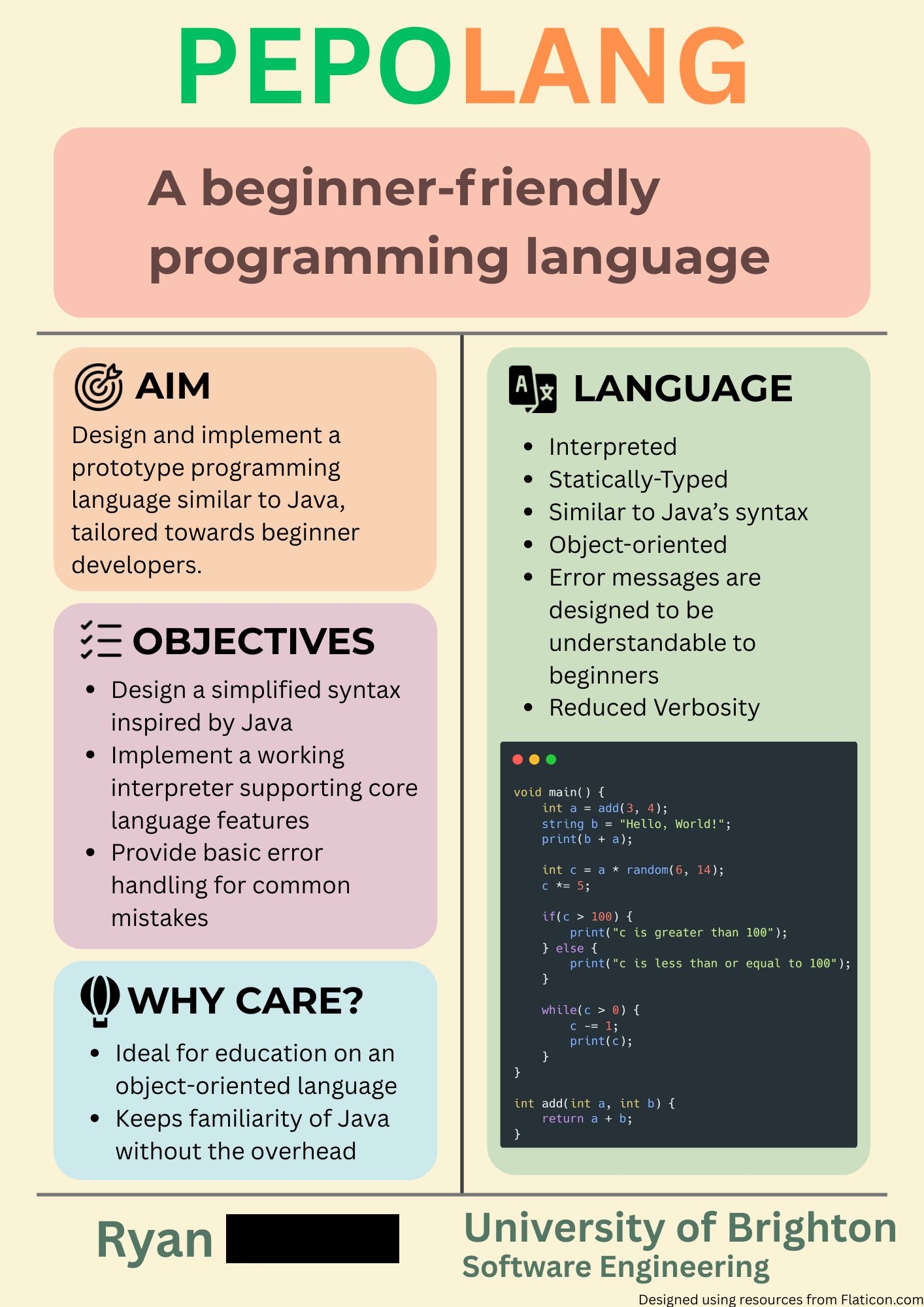
Project Poster
PepoLang Showcase Poster
The coursework poster captures the project summary, implementation path, and the final interpreter-focused delivery in a single visual artifact.